
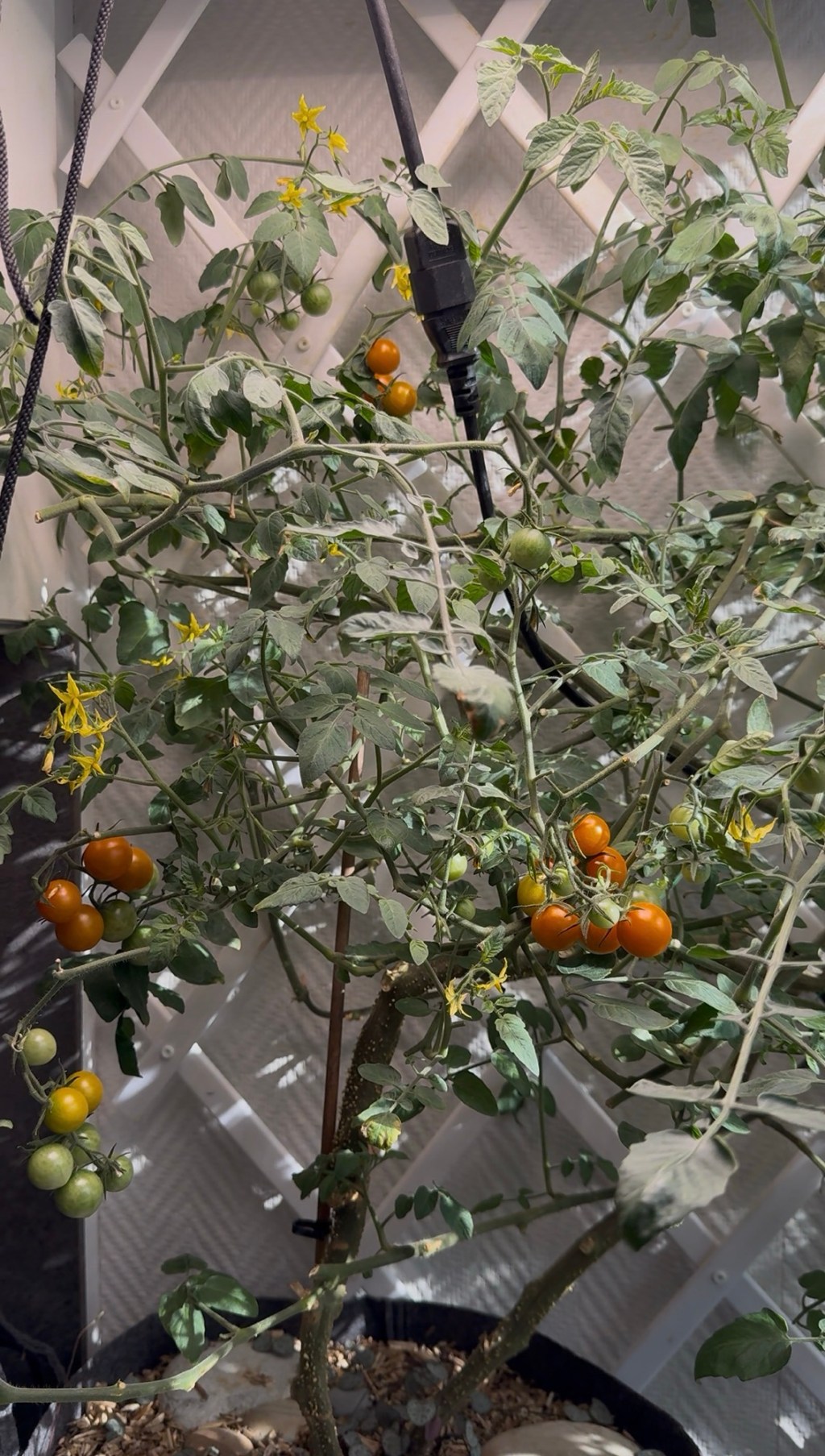
Most people grow tomatoes for one season. I decided to see what would happen if I simply didn’t stop.
I sowed my Sungold tomatoes in spring or early summer 2025, and more than a year later, two of those original plants are still growing and producing tomatoes in my kitchen.
They have been cut back, reshaped and allowed to grow again more times than I can remember. One of them was recently pruned so hard that it was almost bare.
And yet, it came back.
At this point, I’m too attached to it to replace it. Instead, I’ve decided to find out just how long a Sungold tomato can keep producing indoors.

Two Sungold Tomatoes, Two Indoor Setups
My two original plants live in different parts of my kitchen.
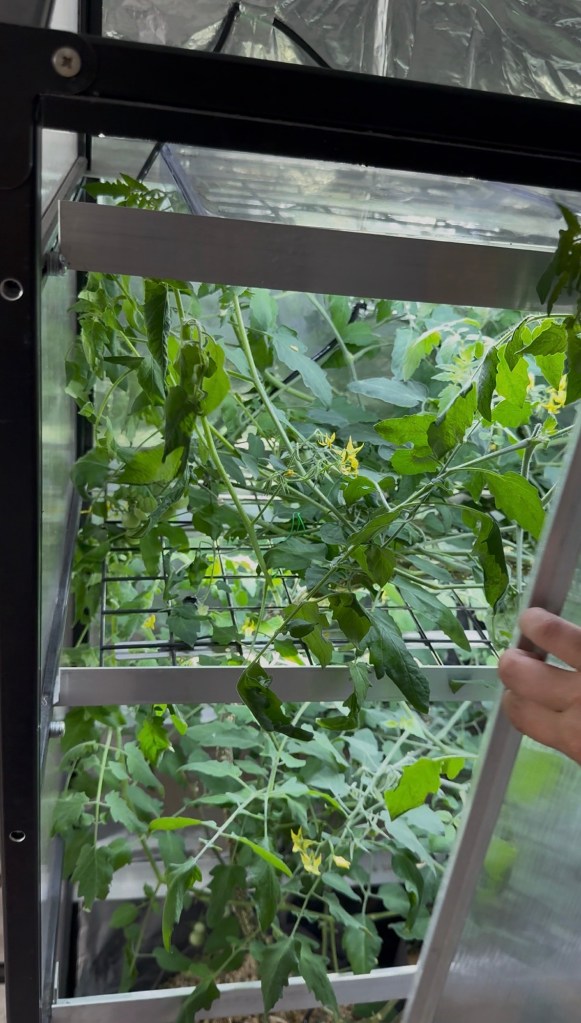
One grows in a fabric pot beside a window under an LED grow light. The other grows in my indoor smart greenhouse, where LED strips provide the artificial light and an automatic system takes care of the watering.
The plant beside the window tends to grow more compactly. The greenhouse plant stretches more between the leaves and flower clusters. My suspicion is that the difference comes partly from the light: the window plant gets both its grow light and natural daylight, while the greenhouse relies on its LED strips.
Both plants still flower and produce tomatoes.
How I Keep an Indeterminate Sungold Small Indoors
Sungold naturally wants to grow as an indeterminate tomato, but indoors I don’t let mine continue upwards as a single long vine.
Instead, I grow them more like bushes.
When a new branch develops a flower truss, I let it flower and then cut the growing tip above the truss. The plant responds by producing new growth elsewhere. I repeat the process as it grows.
This is not the conventional way to train a Sungold tomato, but it has worked surprisingly well in my limited indoor space.
The plants become dense and bushy instead of taking over the entire kitchen — although, given enough time, they still try.
The Tomato I Almost Threw Away
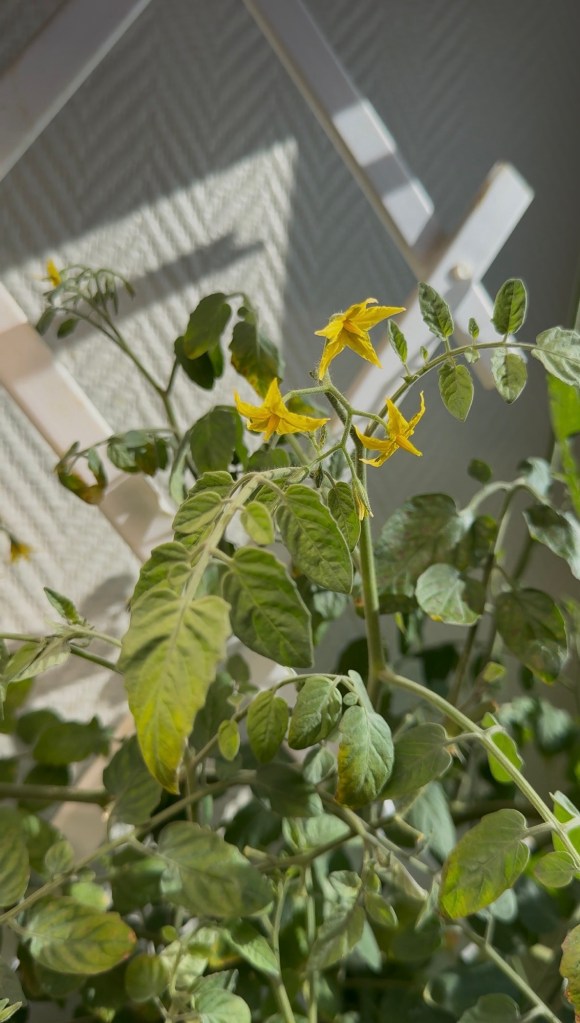
The Sungold beside the window eventually became a jungle.
It had grown extremely dense, and I also noticed something unusual happening with some of the leaves. I seriously considered getting rid of the entire plant and replacing it with a young one.
Instead, I gave it an extreme haircut.
I removed so much growth that the plant looked almost bare. For a moment, replacing it still seemed like the sensible option.
But it started growing again.
Now it is becoming a jungle all over again, flowering and producing tomatoes as if very little happened.
That recovery changed my mind. I’m keeping it for as long as it continues to grow and produce.
Watering, Feeding and Refreshing the Soil
The two setups need slightly different routines.
The smart greenhouse handles watering automatically. The Sungold beside the window is usually watered about every other day, depending on how quickly it is using water.
I give both plants liquid fertilizer approximately once a week.
Towards the end of summer, I also refreshed the top of both pots with fresh potting mix combined with perlite and vermicompost from my own indoor worm bin. I didn’t repot the entire mature plants. I simply added fresh material at the surface.
For pollination, I occasionally vibrate the plants or gently tap the stems when they are flowering. Tomato flowers are self-fertile, but movement helps release the pollen — something that wind normally helps with outdoors.
From the Mother Plant to My Finnish Balcony
This spring, I took a cutting from one of my indoor Sungolds and rooted it indoors.
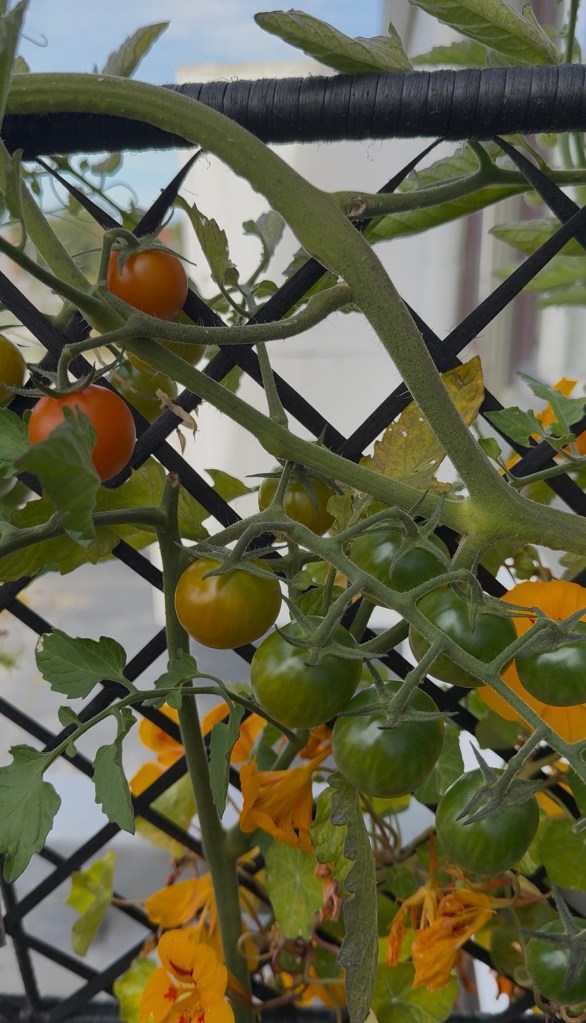
I kept it inside until the weather was warm enough for tomatoes outdoors, then moved it to my open balcony in Finland.
Unlike my indoor plants, I haven’t been repeatedly topping this one into a bush. I have allowed it to grow with one main stem.
That has given me an unexpected little experiment: genetically the same Sungold, but grown very differently.
Indoor vs Outdoor Sungold Tomatoes
The difference became particularly interesting once the outdoor plant started producing fruit.
Right now, its tomatoes are noticeably larger than the tomatoes from my heavily pruned indoor plants.
But I don’t think it is as simple as saying that Sungold produces smaller tomatoes indoors.
When my indoor plants were younger and I wasn’t constantly pruning them into bushes, they produced large tomatoes too. The plants are now older, grown differently and maintained in very different conditions.
The size difference is interesting.
The taste difference is even more interesting.
My outdoor Sungolds are sweet.
My indoor Sungolds are extremely sweet.
The best way I can describe them is like candy. When I eat tomatoes from the indoor plants and then taste the balcony tomatoes, the difference is obvious to me. The outdoor ones are still good and sweet, but they don’t have quite the same intense sweetness.
This is only my observation from these plants and these growing conditions, not a controlled experiment. But it is one of the most interesting differences I’ve noticed while growing the same tomato indoors and outdoors.

Are Year-Round Indoor Tomatoes Worth It?
For me, yes.
Finland’s outdoor tomato season is short. By keeping tomatoes indoors under lights, I’m no longer limited to harvesting them during a few warm months.
My old Sungolds don’t produce a huge harvest every single day. Sometimes there are only a few ripe tomatoes waiting for us; at other times, many more ripen together.
But they keep producing.
More than a year after I sowed them, I can still walk into my kitchen and pick incredibly sweet Sungold tomatoes to snack on.
And there is something I didn’t expect when I first started growing them: after caring for the same tomato plant for more than a year, repeatedly pruning it, watching it recover and seeing it flower again and again, it becomes surprisingly difficult to throw it away just because a younger plant might look better.
So I’m not replacing mine yet.
I’ll keep pruning it, feeding it and letting it grow again.
Now I want to know how long it can actually keep going.


Leave a comment